
The Daily Standard
Story Archive

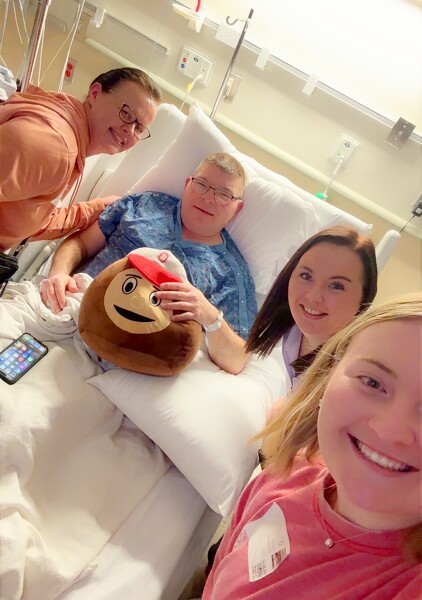
Mercer County Sheriff Doug Timmerman is surrounded by his wife, Jill, and daughters Sammi and Siera at the OSU Wexner Medical Center's Comprehensive Transplant Center.
CELINA - Having been the subject of so many blessings over the course of his lifetime, Mercer County Sheriff Doug Timmerman felt compelled to give back to the world by donating a kidney to a complete stranger.
Not only did the 53-year-old Timmerman gift the ultimate Christmas present to Joy Wagner of Newark, but he was also the catalyst of an intricate, 5-way kidney donor chain involving five living donors and five recipients at The Ohio State University Wexner Medical Center's Comprehensive Transplant Center.
"This generous man, he helped five recipients," said Dr. Amer Rajab, a transplant surgeon at OSUWMC, which performs an average of 600 solid organ transplants each year. "I mean, yes, he could have donated to one, but because of him we were able to do this exchange. … So we had five patients off dialysis by Christmas."
Timmerman said he viewed his kidney donation as an opportunity to pay forward his own good fortune.
"I don't know if I was just in the right place at the right time with running into the right people, but … I've had a lot of good things happen to me, people helping me out," a still recuperating Timmerman told The Daily Standard. "I'm blessed with the family I've got, the friends I've got, the coworkers I've got that made this possible, and I just feel like this is paying back a little of all the good things that have happened to me over my life."
He also drew inspiration from a life-giving gesture extended to a fellow officer.
"I have a colleague who is also a sheriff in Ohio that had his own issues with kidney disease, and he got a kidney a couple of years ago, and obviously it saved his life," Timmerman said. "I reached out to him, spoke to him. Obviously, he was a recipient, but was a very positive person, full of life."
Timmerman's decision to become an altruistic, or non-directed donor, traces back to December 2024.
"My dad had been diagnosed with kidney disease a couple of years ago, and I originally started down this path with the hopes that I would be able to donate to him," the sheriff related. "But because of his medical condition, that didn't allow for it. I was already in the testing process at that point."
Along the way, Timmerman said he spoke with Mercer County residents who had donated organs.
"There are a lot of people in Mercer County (that the general public are unaware) who have donated kidneys," he said. "Several of them I spoke with, and they kind of helped guide me through what to expect."
Timmerman described the kidney testing process as very intense.
"That has to do with your own health to make sure you're donating a healthy kidney," he said. "At the end of May I got the OK from Ohio State saying you'd be a good candidate."
He recalled wondering if his kidney would be a match for anybody out there.
"They kind of shrugged it off quickly and went, 'Oh, you're going to match somebody, because there's 90-some thousand people in the United Sates that are waiting on a kidney,'" Timmerman said.
With the support of his wife, Jill, and daughters Sammi and Siera, Timmerman committed to donating a kidney.
"I've got the best family in the world that's always supportive," he said. "I've got a great sheriff's office family that's supportive, and it made the decision easy."
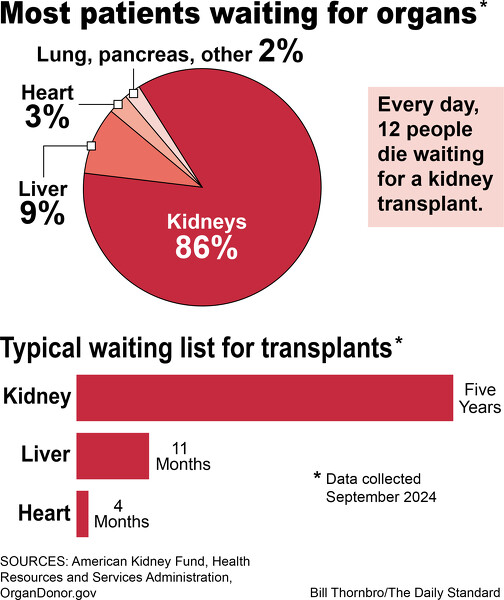
Patients waiting for transplants
Knowing he was a first-term sheriff, OSUWMC staff worked around his schedule, Timmerman said, adding that he was assigned a nurse advocate.
"He said, 'If you can give us a little time to work this through the summer into the fall, we can try to come up with a chain, which we can affect more people at that point,'" he said. "So in November is when I kind of got the word from him going, 'We're ready to go.'"
A kidney transplant chain, according to OSUWMC, is a sequence of surgeries to deliver organs from healthy, living donors to people experiencing kidney failure, with the aim of helping as many people as possible.
Oftentimes family members or friends are unable to donate a kidney to a loved one due to incompatible blood type or tissue, Rajab said.
"And that means that, in many cases, you end up with a patient who is awaiting a kidney and a willing donor who didn't match with their intended recipient," OSUWMC's website states. "A kidney transplant chain creates those matches by allowing donors to give to recipients unknown to them. In exchange, their loved one receives a kidney from a donor previously unknown to them."
Wagner's husband had wanted to donate a kidney to her but his organ wasn't a match, Timmerman said.
"And then Joy's husband donated to another young lady who he matched. She had a family or a friend that donated on her behalf to somebody else and it went on down the line until it gets to the end," Timmerman said of the series of transplants performed.
Kidney transplant chains probably happen less than 10 times a year at OSUWMC, Rajab said.
"We are doing a few hundred transplants a year, so less than 10 times we get people so generous like this sheriff who calls and comes here just wanting to donate a kidney to somebody, literally, and they don't even ask, 'Who is that somebody?'" Rajab said.
Timmerman went under the knife Dec. 12 at OSUWMC. Rajab and Dr. Austin Schenk headed up the two surgery teams.
"Dr. Schenk had harvested my kidney and handed it within seconds to Dr. Rajab, who went into the next room and gave it to Joy," Timmerman said. "It's amazing how they have two separate teams down there. They have a team that is strictly concerned about the recipient or the person that needs the kidney, and I had my own separate team whose only job was to look out for my own best interest."
Indeed, the comprehensive transplant center literally makes the organ transfer almost immediately, Rajab confirmed.
"We like to give the new kidney blood from the recipient within less than 30 minutes after we take it from the other body," he said.
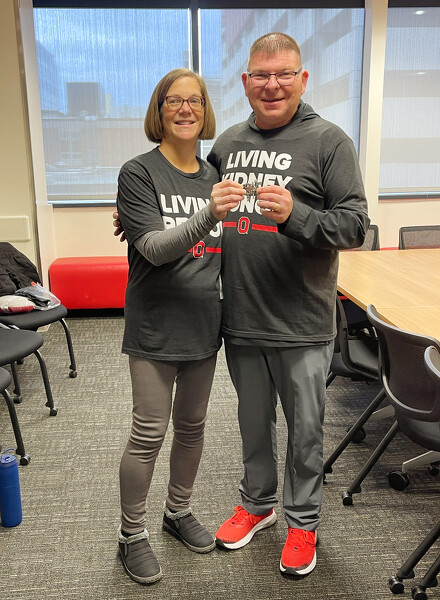
Mercer County Sheriff Doug Timmerman poses for a picture with Joy Wagner of Newark.
Timmerman was able to meet with Wagner prior to being discharged from the hospital on Dec. 14 and then again on Monday.
"She said she's doing great. She's obviously going to have to watch this for the remainder of her life, whether that's anti-rejection medication. We were told yesterday (about) 97% success rates. She's obviously doing everything she can to take care of herself," Timmerman said.
He said he conveyed to Wagner his hope that she lives a healthy life.
"I told her at the hospital … 'I don't ever want to overstep my bounds, but I'd like to stay in contact,' and her exact words were, 'Oh, we're family now.' So we're staying in contact," Timmerman said.
As for himself, Timmerman said he'll have to take care of himself in the future and periodically be retested at OSUWMC.
"It's a significant surgery, and I feel like I'm healing well," he said. "Walking is a big thing, staying very hydrated to protect the one good kidney you have, and simple things like salt intake. You have to watch salt intake."