
The Daily Standard
Story Archive

The Coldwater Creek treatment train is seen in this 2019 file photo.
CELINA - Local wetlands in 2025 fell short of meeting an ambitious goal set by officials yet still managed to have a bang-up year by processing more than 760 million gallons of water and removing a substantial amount of nutrients which fuel potentially unsightly and toxic algal blooms in Grand Lake.
There simply wasn't as much area runoff in the second half of 2025 due to a drought that took hold in the summer and persists to this day. In some months, water flow through wetlands was down as much as 95% from the historical average.
"We had solid nutrient reductions. We had outstanding gallons of water treated, and both of those things translate into reductions in the literal amount of nitrogen, phosphorous and sediments that moves into Grand Lake, makes Grand Lake just a little bit healthier every year," Stephen Jacquemin, an environmental sciences professor at Wright State University-Lake Campus, told Lake Improvement Association members Saturday morning.
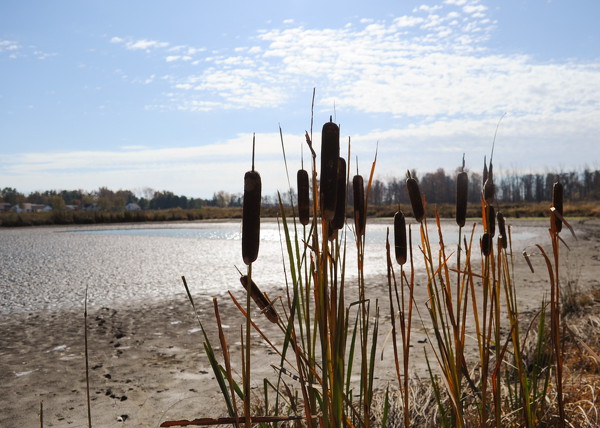
Treatment trains filter out nutrients responsible for toxic blue-green algal blooms in Grand Lake. The vegetative biofilters - primarily composed of wetlands - have been established at Coldwater, Prairie, Beaver and Big Chickasaw creeks.
Nutrient runoff comes from many sources, but in the Grand Lake Watershed, studies show it's mostly from farmland in the 58,000-acre, livestock-heavy watershed.
"All of that water flowing off our watershed, all of that water eventually makes it's way into Grand Lake, and the idea of these natural habitat restorations, the idea of these wetlands is to capture as much of that water as we possibly can, treat it and see where things are at," Jacquemin said.
As the amount of water flowing through wetlands has continued to rise the last few years, Jacquemin had set a goal of 1 billion gallons for 2025.
The first half of 2025 was wet.
"If you look at the amount of the rain for the entire year … the timing of it was extremely weird," Jacquemin said. "Most of our rainfall, most of our hydrology, most of our hydrologic loading, most of it came in the winter … and into spring of April."
But by June, a drought developed, and those aforementioned metrics dropped precipitously. For the entire year, the area saw a mere 25.93 inches of rain, way below the annual average of about 45 inches, noted Grand Lake St. Marys State Park Manager David Faler.
The effects are still felt today, as much of Mercer County is in an extreme drought, U.S. Drought Monitor shows. The lake's water level is currently negative 12 inches, Faler said.
"Once we hit sort of May or June, our values for how much water is actually flowing into the lake, how much water is raining down, our values really plummeted, and we entered into a sort of drought period," Jacquemin said. "Some of the … biggest ways to sort of recognize that is looking at the average creek flow."
Big Chickasaw Creek's average daily flow in December was 1.2 million gallons, dramatically lower than the historical average of 13.6 million gallons a day, according to Jacquemin.
"You look at November. The average is 8.4 million (gallons a day), and what we saw this past year was about three-quarters of a million (gallons a day)," he said. "Some of these months throughout the year, we're talking anywhere from 65 to 95% reductions in flow compared to what we have historically had."
Nevertheless, local wetlands ended up treating more than 760 million gallons of water in 2025.
"This is a big number," Jacquemin said. "If we look at how that stacked up to last year, we were about 620 million gallons, and the year before that, we were at about 440 million gallons."
These escalating figures, Jacquemin insisted, constitute a trend.
"We'd like very much to see these flow totals continue to go up because every single gallon that moves through these wetlands is a gallon that gets treated, and it's a gallon that discharges in a much improved manner into our lake, which helps everybody," he said.
Coldwater Creek and Prairie Creek treatment trains far and away processed the most water in 2025.
"But Prairie Creek is a smaller stream to begin with, but if you stack up the number of gallons treated by the wetlands compared to the number of gallons that move through those creeks, both of these systems treated about 15% of every drop of water that flowed through those streams," Jacquemin said. "That's a great number."
Beaver Creek, the watershed's largest tributary, treated 3-4% of the annual flow.
"I'm happy to announce that we have received some EPA 319 funding is conjunction with the county," he said, thanking Mercer County agriculture and natural resources director Theresa Dirksen. "There's another pump station that's going to be installed at Beaver Creek, so hopefully that in a perfect world, that doubles that number for next year."
Moving on, Jacquemin said the amount of nutrients prevented from entering Grand Lake in 2025 was exceptional.
"We can look at sites like Coldwater Creek. Close to 10,000 pounds of pure nitrogen was removed over the course of the year," he said. "This is outstanding. Close to 600 pounds of pure phosphorous removed. Close to 100,000 pounds of sediment removed."
Similar outstanding patterns were measured in Prairie Creek.
"Beaver Creek was able to to grab close to 9,000 pounds of pure nitrogen, was able to grab a couple hundred pounds of phosphorous and was able to grab around 15- or 20,000 pounds of dirt," he said.
Meanwhile, Big Chickasaw Creek removed about 100 pounds of phosphorous, up to 3,000 pounds of nitrogen and roughly 30,000 pounds of total sediment, Jacquemin continued.
Jacquemin stressed that nutrient reduction via wetlands is a balancing act.
"When you look at these concentration reductions, it'd be great if we had a 100% reduction in phosphorous, 100% reduction of nitrogen, 100% reduction of sediment with every gallon moving through these wetlands," he said. "But if we achieve that, we might be sacrificing the amount of water that can move through these sites."
Captured nitrogen eventually moves into the atmosphere. However, phosphorous, which doesn't have an atmospheric component, accumulates in the wetlands, Jacquemin pointed out.
"It depends on the wetland, and it depends on the amount of things going into it, but at some point, there's some annual maintenance that needs to happen," he said. "If anybody has driven by Prairie Creek over the last week or so, you have seen some of that annual maintenance happening. Currently Prairie Creek is just about at capacity in terms of the amount of sediment and (phosphorous) that it can accumulate."
Excavators are digging out the main settling pools and resetting the system for the spring.
"That earth that gets moved out, it goes into similar places as where our dredge material goes," he said. "It goes into spots around the watershed where it can slowly dewater safely and then hopefully get put to beneficial use as fill dirt or whatever it may be." Touching on precipitation, Faler said the area has experienced rainfall below normal levels for the last four years.
"Average rainfall for … this area in Ohio is roughly around 45 inches a year," Faler said.
Faler said there were 32.76 inches in 2022, 31.99 inches in 2023, 34.54 inches in 2024 and 25.93 inches in 2025.
"We were way down, which was great for nutrient uptake for the lake and the wetlands," he said.
So far this year, 0.55 inches of rainfall were recorded in January, compared to 1.51 inches the same time last year.
"We're at a baseline. Hopefully this doesn't continue because … last year was a drought year," Faler said.