Monday, February 16th, 2026
Washington's Favorite General Instrumental in the Revolution
Area historian recounts Greene's life, career
By Abigail Miller
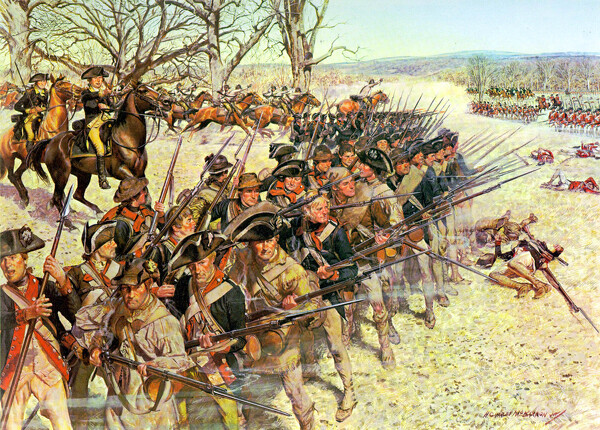
Gen. Nathanael Greene led the Battle of Guilford Court House in 1781. Greene's campaign led the British into poor decisions that resulted in their surrender to Gen. George Washington at Yorktown.
CELINA- Commonly known as the Savior of the South, Nathanael Greene defied all odds on his pursuit of notoriety and American independence, ultimately earning the coveted title of George Washington's favorite general.
About 25 locals learned about the war hero's life from Riley House Museum Director Cait Clark on Sunday afternoon at the Richardson Bretz Building in Celina. The lecture served as a kick off to the Mercer County Historical Society's yearlong series on Washington's generals in accordance with the country's 250th anniversary.
Also referred to by Washington as "the man of the hour," Greene was born in July of 1742 in Rhode Island. At the time, the colony was unlike others in that its governor was elected by its citizens and not appointed by the King of England.
"Beyond that, you could practice any religion in Rhode Island, which was highly unusual," Clark said. "You could practice any religion as long as it didn't harm anyone else around you. So you could be Jewish in Rhode Island, you could be a practicing Catholic in Rhode Island, as long as you didn't hurt anybody else."
This heavily influenced Greene, who was born a Quaker only to be banished just before the war after he was spotted at a common house, otherwise known as an alehouse.
"He had a hand in the family business from a very, very young age. The family business was named Nathanael Greene and Company, named after his father. They had a sawmill, an iron forge, a small farm, and they were very successful in these endeavors for quite some time," Clark said. "So from a very young age, young Nathanael, his brothers, they were in charge of keeping the ledgers even before they were teenagers. So they had a reasonable enough education enough that they could keep numbers and they could read. But remember I said they were also Quakers, and being Quaker meant that any kind of book learning led to essentially temptation, heresy and sin. So they did not want the boys to be studying anything beyond Quaker approved books. It was better to be simply educated."
Well, this did not settle with young Greene, who was later on quoted saying, "Quaker belief has proved to be a fine nursery of ignorance."
"And further than that, he even said very early on, 'I should have been in the pursuit of knowledge. I was digging into the bowels of the Earth after wealth,'" Clark added. "So you see young Nathanael Greene, he was aware of this. And as a result, in his early years, he would always be reading. He'd be working the forge and reading a book. He'd be at the saw mill supervising, and he'd be reading a book. A lot of these books that he was reading were not approved Quaker Books. In fact, he was studying military strategy. And after his father's death in 1770, it became even more prevalent. He was actively pursuing non-Quaker approved information."
Greene began his military career by joining the Kentish Guards in 1774 as a private, Clark said. A limp leftover from a childhood illness was the only thing stopping him from an officer title.
"His own neighbors walked up to him, and they would say that he was an embarrassment for the Kentish Guards because of his limp," she said. "He almost left, but fortunately he didn't because on April 19, 1775 rolls around the battles of Lexington and Concord."
Even though they were up in Rhode Island, the Kentish Guards were very aware of what was going on, Clark said. So after the battles of Lexington and Concord, Rhode Island decided to create an army of observation to protect the people because they saw it as a direct threat to democracy.
After this, the governor of Rhode Island, who opposed the creation of this army, was deposed. The assembly then elected none other than Greene to be the new general of this army of observation.
"In just six months time, he went from being a private, who was an embarrassment, to being the general of all of these men who said he was an embarrassment," Clark said. "And his orders as the general of this army, were very simple. They were: resist, expel, kill and destroy any enemies who were a threat to the American people."
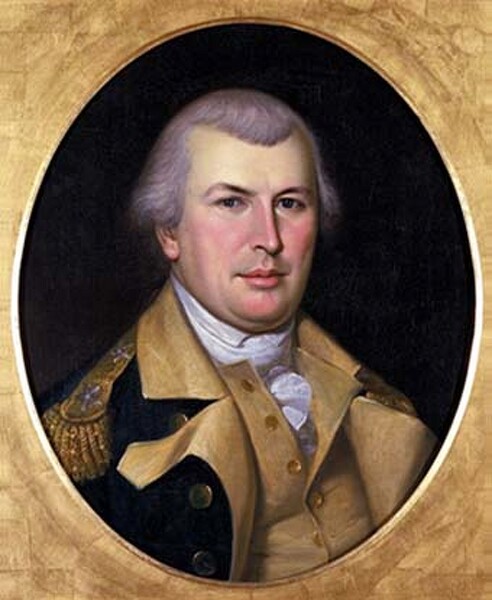
General Nathanael Greene. Photo courtesy of National Park Service.
After Lexington and Concord, the British were sequestered in Boston and surrounded by militias that were "very, very angry," Clark said. Greene and Rhode Island's army were among those militias encamped outside of Roxbury, Massachusetts on the outskirts of Boston.
While there, the Quaker-raised Greene was "appalled" by his soldiers' behavior, she said.
"He tried to ban, in fact, just vulgar language of any kind, which, as you can imagine, went really well. You can't really ban men of this caliber from cursing. But Nathanael Greene, he started to crack down," Clark said. "He put in place several rules, for instance, unfit soldiers that were deemed so had to have an extra hour of physical activity every day. And not only that, but there would be no selling of alcohol within the military camp. If you had no shoes on and you were barefoot, you weren't allowed on the parade ground and absolutely no card playing- that just leads to the work of the devil."
Greene's peculiar rules earned him a lot of attention, as it was soon obvious that the men under his command were some of the most well-trained in the entire outfit surrounding Boston, she said.
Once the Continental Army was formed, Washington named him its most junior brigadier general, along with its least educated and experienced.
"Perhaps this was because the Greenes were such a well-to-do family in Rhode Island, or perhaps it was because of Greene's own forceful personality, either one of these could be reasons that Greene was put on Washington's staff," Clark said. "In any event, on July 4th, 1775, exactly one year before what would become Independence Day, Washington and Greene meet face to face for the first time."
The two were complete opposites, she said. Washington is Anglican. Greene is a Quaker. Washington comes from a very aristocratic background in Virginia, and Greene comes from Democratic Rhode Island. Their personalities were very different as well. Washington is known as being remote, aloof, not prone to emotional outbursts, whereas Greene, he's very amiable, and sensitive to any form of criticism.
At the same time, they also had a lot in common.
"For instance, they're both very aware that they're poorly educated. Neither one of them have a formal education. And not only that, but they both want to escape the social status that they've been born into," Clark said. "Because in the America that they believe is possible, they believe that anyone can be great, which is a founding belief of America. It doesn't matter who you're born as or where you're born, you can be great- and Washington and Greene both believed in that."
Through their friendship, the duo led the Continental Army through many defeats and several key victories. Greene went from being a general, to quarter master, and back to general, only to ultimately be chosen by Washington as the Commander of the Southern Department of the Continental Army.
In this role, Greene was able to do what none of the commanders that came before him- Charles Lee; Robert Howe; Benjamin Lincoln; and Horatio Gates- could do: conquer the South.
Greene did so in an unconventional way, Clark said, by losing battles. Through several pyrrhic victories, Greene was able to force the British to withdrawal to Yorktown, Virginia.
A Pyrrhic victory is success that inflicts such devastating cost to the victor that it's equal to a defeat, Clark said.
Ultimately, once the British made it to Virginia, Washington and his French allies trapped and forced the surrender of British General Lord Cornwallis-Greene's arch enemy- on Oct. 19, 1781- effectively securing American independence, Clark said.
In his short lived post war years, Greene retired to his Georgia plantation, called Mulberry Grove, just outside of Savannah with his wife and four children, Clark said.
"He went home to Rhode Island, packed up his family, and then moved down to Mulberry Grove in Georgia, where Greene said, 'Nothing can be said in slavery's defense,'" she said. "Even though he would become a slave owner, he did not support slavery, ultimately, at Mulberry Grove. When they were living in Mulberry Grove in 1785, things started to really look up."
When then Secretary of War Henry Knox learned that Greene was only a slave owner because of all his outstanding debts, he went to Congress to persuade them to forgive Greene's loans.
"More significant than that, Anthony Wayne would become Greene's next door neighbor, (at) the nearby plantation," Clark said. "Just a few days before June 19th, Greene would go to Savannah, Georgia to visit a friend. It was during this visit that Greene started complaining that he had a headache. He visited his friend's plantation, walked around. It was a very hot day. Later that evening with his headache, he laid down to take a nap and lost consciousness. Over the next few days, Greene would go in and out of consciousness, and doctors would diagnose him with severe sun stroke."
He died not long after on June 19, 1786 at the age of 44, with his wife Katie, and friend Wayne at his bedside.
"Anthony Wayne wrote later, he said, 'My feelings are about too much effect because I've seen such a great and good man die,'" she said. "… Anthony Wayne would go on to be a significant participant in the Northwestern Indian Wars. He would go out into the Ohio territory, and he would establish the largest wooden fortification ever built on American soil. Today, that wooden fortification is Greenville, Ohio, just south of us, named after his friend whose bedside he sat at as Greene died."
Clark added that Greene County, Ohio was also named after the war hero, along with a good chunk of all the other U.S. cities called Greenville, of which there are many.
"The city name of Greenville is the fourth most popular name in the United States today, and one-third of those cities named Greenville are directly named after Nathaniel Greene," Clark said.
The Mercer County Historical Society will continue its Washington's Generals series next month with a lecture from Clark on General Daniel Morgan- who's widely known as a "Rebel with a Cause," Clark said.
More information can be found at
therileyhousemuseum.org.