
The Daily Standard
Story Archive

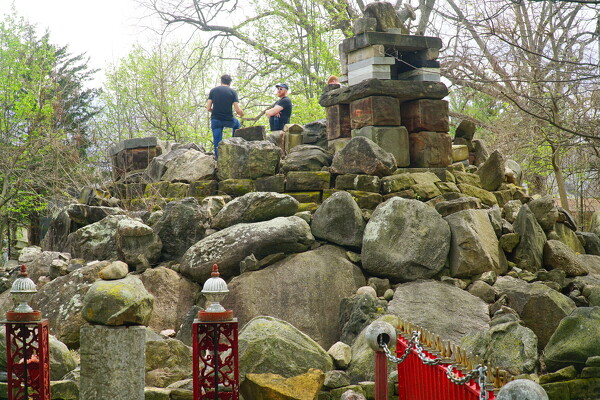
The Temple of Tolerance in Wapakoneta is a massive stone creation weighing more than 100,000 pounds in all.
WAPAKONETA - Though prolific Renaissance man Jim Bowsher has been gone for nearly two years, his spirit remains firmly imbued within The Temple of Tolerance, a primitive/visionary art site sprawled along 2 acres of residential property in Wapakoneta.
The outdoor bricolage consists of massive rough-hewn stones, glacial rocks, concrete pillars and statues, and other seemingly miscellaneous items - horseshoes, porch swings, keepsakes - arranged amid winding pathways and a bevy of trees and vegetation.
Together they manifest as a philosophical concept, more a state of mind than a place, according to a gravestone-like marker that sits in a series of rocks encircling the site's central temple.
"Jim claimed that he visualized the entire yard before he built it," noted Scott Bruno, Bowsher's friend, site trustee and website caretaker.
Since its formal completion in 1999, the temple has drawn people from far and near, across counties, states and even oceans. Falling under its pensive spell, some may call the enigmatic site sacred.
"Basically he bought the back of six properties around the block, so he ended up buying the center of the block," Bruno said. "He said he completed it in '99, but in reality, he kept adding on. … He bought another small property in 2017 and built … the Memorial to Ohio War Dead."
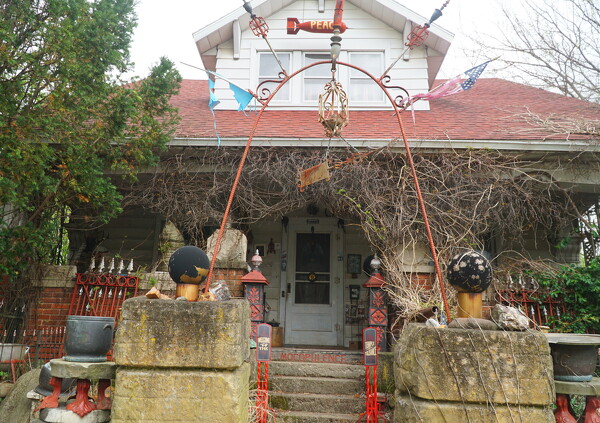
Jim and Walt Bowsher's childhood home serves as the entrance to The Temple of Tolerance at 202 S. Wood St. in Wapakoneta.
Accessible via the driveway to Bowsher's childhood home, the refuge from modernity is free to explore from dawn to dusk everyday. Free-will donations are accepted.
A group of students and professors from the Ohio State University at Lima stopped by for a visit of the temple Friday afternoon. They were given a brief history of what has been called Bowsher's master work, by his brother, Walt Bowsher; and Bruno.
"I think they just hear about it," Bruno said when asked what lures people to the temple. "There are a lot of people that feel like it's a meditative space. They talk about it on those sort of terms. It's like a weird thing that you don't really see that often, that people create something for their yard: Let's just invite everyone to it.
"You just sort of absorb the energy of the place. These rocks are like millions of years (old), some of these rocks. You're in this environment that takes you out of your everyday life."
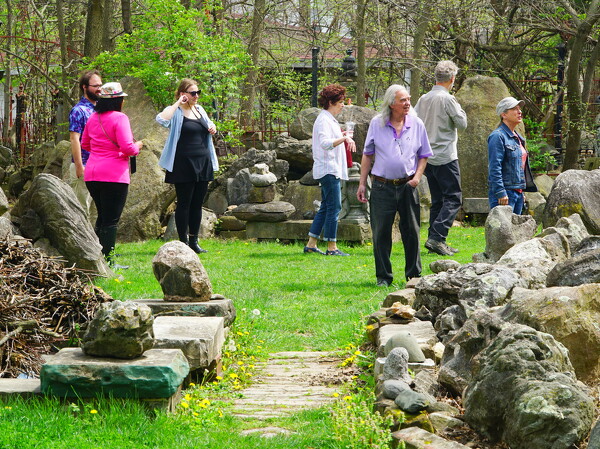
A group of students and professors from the Ohio State University at Lima stopped by for a visit of the The Temple of Tolerance in Wapakoneta Friday afternoon. They were given a brief history of what has been called Bowsher's master work.
Everyone has their own motivations for coming back to the temple, added Terry McDonald, the municipal clerk of the City of Wapakoneta, and administrative assistant for The Heritage Trails Park District.
"Some people, it's a great meeting place with friends, and it's free and open to the public, which I think was really important to Jim. It's a way to cross paths with people that you maybe wouldn't in your own routine, your day-to-day life," she said. "But some people come back here to play music. Some people come back … to meditate, or to have a quiet space."
Not everyone, McDonald said, grows up with a nature habitat in their backyard.
"If they lack that, this is something that local people can come and see birds and sit under a canopy of trees - and then take in all the artifacts. You often leave with more questions each time," she said.
There's so much to see on the temple grounds - a cottage built in the shape of a barrel, the doors from a a jail cell that once held members of the Dillinger gang, as the website Jimbowsher.com points out - that each visit yields new revelations.
"I just think it's a little bit like exploration," Bruno said. "I've been here a dozen times or more, and I've never gone over by that fence, and all of a sudden, there's like a new thing that I've never seen before."
McDonald expressed similar sentiments.
"I have come in all seasons because I love appreciating how different it looks in all seasons," McDonald enthused. "You come when you're in July, and this is all walled-off by vegetation. So each section you go in would be like a whole different environment in July. Then, when you come in December and it's all snow-covered and you can see right through it."
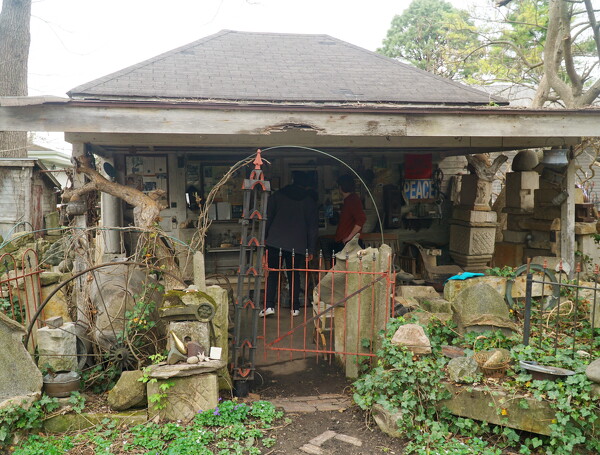
What started as a refuge for troubled teens has turned into not only a local tourist attraction, but a nationally recognized must-see location.
The advent of Jimbowsher.com, which pays homage to the eponymous local historian, archeologist, folk artist, collector and storyteller, along with exposure elsewhere on the internet and in books, sparked additional interest in The Temple of Tolerance.
"I think that website has helped a lot," Bruno agreed. "I mean, some fairly well-known people have been here. Johnny Depp's been in the yard. … I think (Bruce) Springsteen has been here. Country Joe from Country Joe and the Fish, he's been here. Tim McGraw has been here. Jim talked with him."
Back in 2015, Jim Bowsher told The Daily Standard that he had always known he wanted to help kids in need but he didn't conjure up the best way to do it until 1981. That year, he envisioned a place where they could come for tranquility, trust and comfort.
He said most of the place was built using only a backhoe, a dump truck and the help of the troubled teens he wanted to help.
"I wanted to make the yard so unique to draw those kids in and let them know it's theirs and nothing is more important than them in the garden," he had said.
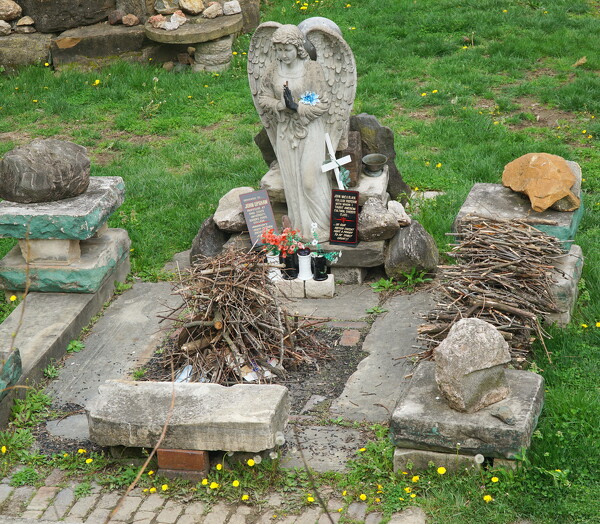
The Temple of Tolerance in Wapakoneta and the surrounding grounds in many ways reflect Jim Bowsher himself. It sprawled straight out of his imagination into his yard. Every stone, every rusty horseshoe, every porch swing had a meaning to the man.
Plenty of children still make their way to The Temple of Tolerance, according to Walt Bowsher, who has assumed the role of site specialist in the aftermath of his brother's passing.
"Basically the whole building of it was just as a temple for tolerance and for kids, kids to play on, and they do," Walt Bowsher said. "Sometimes from Lima, whole busloads of kids will come down like in the fifth grade, fourth grade. … They just swarm over this thing like a bunch of locusts."
Other visitors on Friday shared their impressions of the temple with the newspaper, including art professor Ian Breidenbach.
"This is a level of influence that I like to see a singular person have on their world," he said. "And I think that that is largely squashed by normal everyday life, and so this sort of thing really is inspiring (in that) you could do this. If you have space, there's nothing stopping you from doing whatever you want."
Breidenbach's student Colin Polsdorfer said this was his first time at The Temple of Tolerance despite having lived with his family in Wapakoneta for the last three years.
"We would pass by this house, and we always would admire the architecture of it, but never knew all this was back here until (Breidenbach) told me," Polsdorfer said. "Oh, this is actually something to go and see and check out, and so I decided, why not? I'm only down the road from it."
Polsdorfer was quite taken with the provocative place.
"It is really cool. I do love seeing this kind of stuff and anything new," he said. "Just a break from the monotony of regular everyday stuff, going out and exploring something."
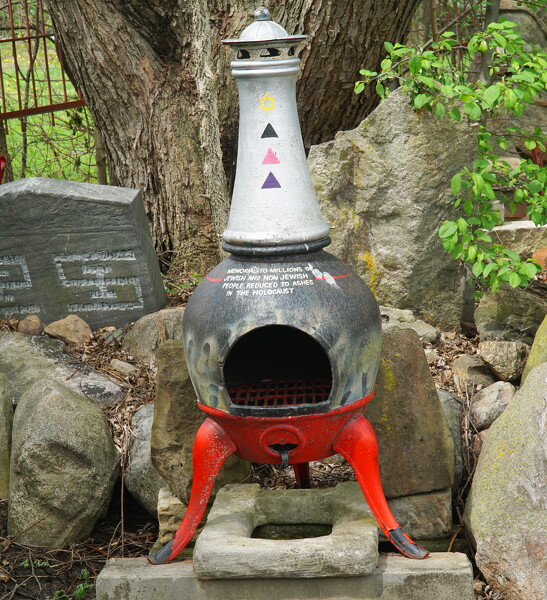
There's so much to see on the The Temple of Tolerance grounds that each visit yields new revelations.
While speaking to the newspaper a decade ago, Jim Bowsher described himself as both a "militant humanitarian" and a "voice for the voiceless."
Bruno reinforced that assertion.
"He taught like writing classes in prison, and he always believed that people were innately good," Bruno said.
Jim Bowsher said his life had been a battle between an ego that drives him and a sense of identity that grounds him. He needed both to reach his goal because it wasn't easy to build such a place.
"The temple took me almost a decade to complete. I started working on it in 1990 and finished Sept. 9, 1999, at 9 p.m. 9-9-99 at 9," he said.
Before Jim died from cancer in June 2024, he and Walt donated a sampling of their personal Native American artifact collection for public display in the Auglaize County Administration Building in Wapakoneta. Most of the items were unearthed in Auglaize and surrounding counties.
Efforts are afoot to preserve The Temple of Tolerance for posterity.
"We're kind of in a transition with the property right now," Bruno said. "We're overcoming a few legal hurdles with eventually creating this trust."

The Temple of Tolerance in Wapakoneta and the surrounding grounds in many ways reflect Jim Bowsher himself. It sprawled straight out of his imagination into his yard. Every stone, every rusty horseshoe, every porch swing had a meaning to the man.