The Daily Standard
Story Archive

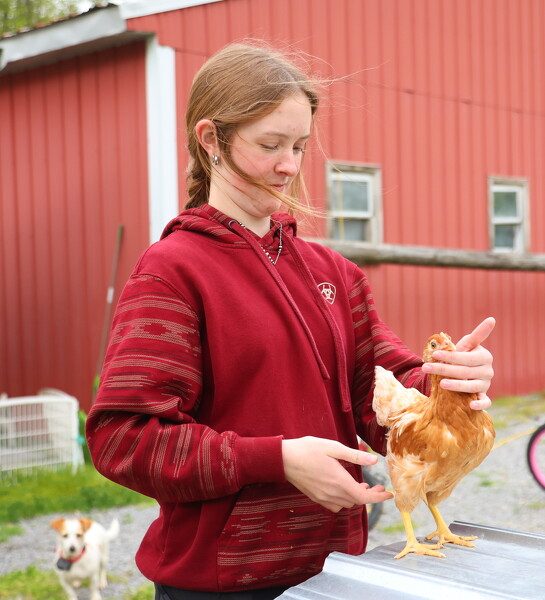
Washington Winners 4-H club member Harper Post, Celina, practices showing one of her chickens at her home in Celina.
CELINA - Excitement is building among certain FFA and 4-H members for the 2026 Mercer County Fair, which will see the return of live poultry exhibits following a year off due to the threat of Highly Pathogenic Avian Influenza.
The exhibits and showings of turkeys, roasters, broilers, layer hens and other poultry entries will also take place in a new location boasting additional space and a show arena this year, injecting another dose of exhilaration into the program.
"I think they're extremely excited to come back, and especially with the new barn and room to grow, all the kids are looking forward to it," Amanda Stachler, the adult supervisor of the fair's poultry program, told The Daily Standard.
Consequently, the number of kids committed to bird-related entries this year - 52 - is up over 12% from 2024, according to Stachler.
Needless to say, the FFA and 4-H members are counting the days until the 2026 fair, which runs Aug. 13-19.
"I think it's pretty important," Stachler said about the live poultry events. "It's kind of like the conclusion of your project, to be able to bring it to the fair and show off to the public, 'Hey, I raised this from a chick.' I think it's pretty special. I mean, you put in your time and effort through the hot summer days out there preparing, and when we get close to the fair, they're sitting out there, washing birds and stuff like that, so it's kind of like a full circle moment."
Organizers in early February 2025, just a few weeks before the participants' layer hens were to arrive, moved to axe live poultry exhibits from the 2025 Mercer County Fair to mitigate the spread of bird flu that was ravaging the county at the time and protect the health and safety of the community.
Exhibitors, though, still had opportunity to participate in poultry projects through livestock interviews and alternative activities. They also could switch to a different project before the March 1, 2025, deadline.
"There was disappointment, and I made the show as best as I could," Stachler said. "We still kind of had a show. It was more like trivia. …It's like poultry questions, and I had them break up into teams, and we played games, and my goal last year was to fill the barn as much as possible. So I had to make paper chickens, and we put those around the barn, and the kids still made posters. So there were still things for them to do, but they were still a little bummed they couldn't actually bring chickens."
One of the crestfallen exhibitors was Harper Post, a member of Washington Winners 4-H club and a freshman at Celina High School. She had to scrap her plan of entering bantam fancy birds in last year's fair.
"I had hatched some chicks. I wanted to see how they would do, and I had a lot more than I did in the previous years," she recalled. "I wanted to see how they would all do, and I was excited for how the outcome would be."
However, Harper, now in her fourth year of raising chickens, took part in the alternative poultry project.
"She still wanted to show something, so she debated on what she was going to do and ended up deciding on doing market goats last year," Harper's mother, Rachel Post, pointed out.
Ultimately, the kids understood the gravity of bird flu and the decision to clip the live poultry exhibits from the 2025 fair.
"I kept telling the kids, 'We have to keep the county safe, and if you have birds at home, still practice your biosecurity to keep your flock safe, and that's all that we can do right now until we figure something out," Stachler said. "But I feel like also this year they're a little more leery about what could happen, and I'm like, 'It's OK. If something happens, we'll make the best of it."
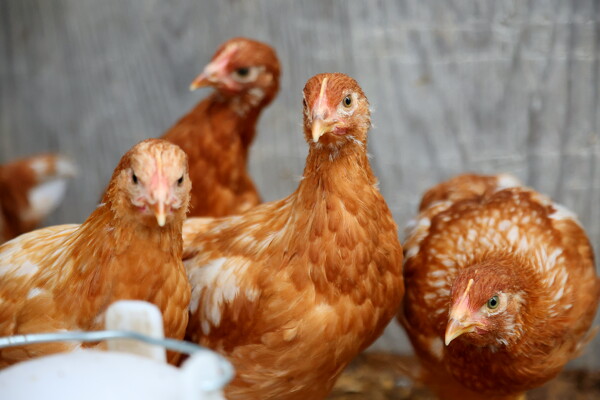
One of Washington Winners 4-H club member Harper Post's current projects include layer hens like these. Post will bring three hens along with 12-14 eggs to the fair where the judges will judge each hen and egg based on how well matched they are and their characteristics.
The FFA and 4-H members will have a new place to showcase their birds this year.
The Grand Event Center is making its debut at the fair and will host equine and beef cattle, feeing up space elsewhere on the fairgrounds.
"The poultry will be moving into their own space," fairgrounds executive director Cara Muhlenkamp told the newspaper. "They will have a barn designated just for them, and the old space for poultry will open up for rabbits to expand and grow."
More specifically, the poultry will move into the horse barn, according to Stachler.
"The plan is to make an arena in there as well, so all of the poultry stuff will happen in that barn, and I think it's going to be a good thing because it's going to be a biosecurity-central-type deal," she said. "We are getting a lot more space. I actually had to order 200 new cages: We are getting a lot more cages. We're going to be able to add more turkey pens, more meat bird pens, just pens overall. We're going to have room to grow, and I feel like that's what I'm most excited about."
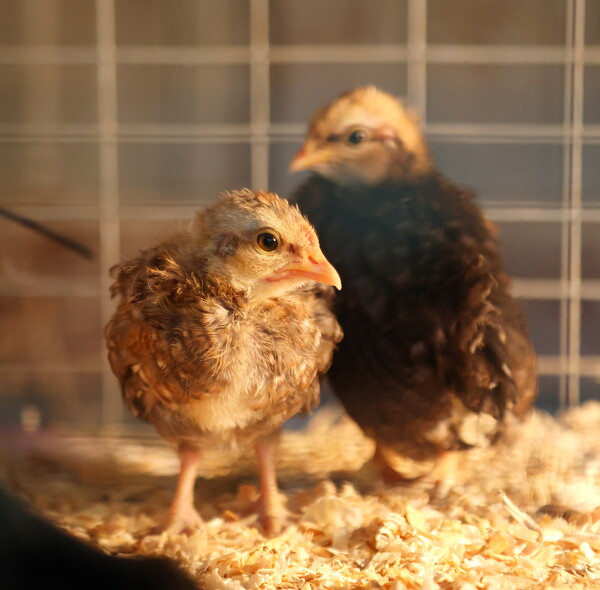
Growing animals from chicks until they're ready for showing at the fair is a big part of FFA and 4-H poultry projects. With the Grand Event Center housing equine and beef cattle, freeing up space elsewhere on the fairgrounds, the poultry will have more room this year in the old horse barn.
Stachler, who comes from a family of farmers, joined FFA her freshman year at Parkway High School and began showing at the fair. She never looked back, going on to earn her American FFA Degree, the highest degree achievable in the national FFA organization, and become an adult supervisor of the fair's poultry program at an early age.
"I actually started showing 2011-2012. It would have been my freshman year of high school, and I didn't really leave," she said. "I made really quick connections with the superintendent at that point, and joined the junior fair board. Even at one point, I moved away to college and came back and was home (for fair activities). I made sure that my schedule would let me come home."
Stachler said poultry is an excellent way to begin exploring livestock. In order to show poultry, youth must be members of FFA or a 4-H club.
"Poultry is like the gateway livestock," Stachler said. "You can always get 12 hens and raise them in your backyard and sell them after fair. It's not like a steer or a hog that you have to have a full-blown barn to make or to use. But I feel like the kids will come and stay. They don't really leave. They may venture out and show like my brothers did. They went and showed steers or they went and showed goats."
Additionally, raising poultry is considerably more affordable than other types of livestock.
"You can buy birds relatively cheap. They're not as cheap as they used to be, but they're still relatively cheap - and to feed them is cheaper than a steer," she said. "And you're only raising, say, turkeys for four months, six months, and you're only raising your meat birds from June to August. So it's a pretty quick turnaround."
Another perk of raising poultry is becoming a member of a like-minded community.
"I loved the family aspect," Stachler said. "I always looked forward to fair week. During the show day we would always have a meal that we would sit down to as a group. We have like a family carry-in, basically, and it was like one big group. Even the kids you don't see outside of fair week, you're still pretty good friends. I've made friends from other schools that I still talk to, and you kind of stick with it. We all go to open shows from time to time together."
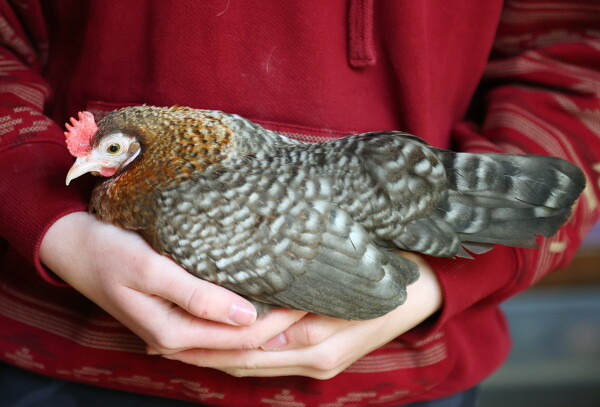
Washington Winners 4-H club member Harper Post's holds a fancy breed chicken at her home in Celina.
Harper and her four siblings live in a bucolic dreamland with their parents, Rachel and Jeremy Post, outside of Celina on a spread they share with goats, horses, chickens, dogs and cats.
"We have like a whole mini little farm here of animals, just because we have kids that love them," Rachel Post said. "She's very responsible and knows to take care of them and what to do, and she also helps instill that in her younger siblings."
Harper's definitely taken a shine to animals big and small and dreams of one day becoming a veterinarian. Raising chickens - and now goats - brings her a step closer to learning the ins and out of animal care. Prior to COVID, she obsessively watched veterinarian Dr. Pol on TV.
"She's always loved animals, always has, and then COVID, when we were all stuck at home, how many toads did you have?" Rachel Post asked her daughter. "She researched a lot of things about the animals on what their habitat needed to be, what they eat. And so, that was our entertainment during COVID. We were watching random animals. She's just always loved animals and kind of figures out what they need. We've had chickens for a long time, since she was little."
It's pretty easy to take care of the chickens, Harper said.
"I give them feed and water every day and then about a couple times during the week I give them shavings," she said.
"Just wood shavings, to keep their cages cleans," her mother clarified.
Harper said she hasn't faced too much difficulty in keeping her chickens alive.
"The winter is really hard on them," she said. "When it's cold out, we put the panels up on their barn, and their cages, we block it with a tarp, and I put straw in there and they have heat lamps. And whenever it's hot out, I usually try to give them a fan and cold ice water a lot."
One year some of the birds came down with respiratory problems.
"It just affected a few of them, but it wasn't too bad," she said.
Harper also explained one of her current fair projects, layer hens.
"We have to get 12 minimum laying pullets, and I'll raise them up until they lay eggs, and then I'll bring three of them to the fair, the ones with the best qualities and that are laying for sure," she said. "They'll judge the eggs. I'll bring, I think, a dozen or 14 eggs, and they'll judge each egg, and they'll show judge the chickens on how well matched they are and their characteristics."
Harper said she feels good about her project four months ahead of the fair.
"It's just nice to have a bond with an animal, and I feel like the animals teach you a lot of lessons that you wouldn't learn from people," she said. "It's just a really good thing to do."