The Daily Standard
Story Archive

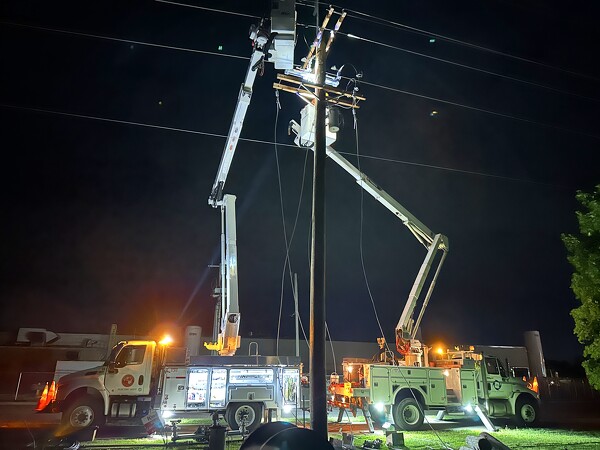
Crews worked grueling 16-hour shifts to restore power the week of June 11.
CELINA - Since joining the City of Celina's electric department in 2006, electric distribution superintendent Aaron Siefring has experienced five major storms, including four tornadoes, that caused significant damage and left the city in the dark, necessitating an all hands on deck approach to restoring power.
The dates of those extreme weather events are etched in his brain, including June 11, 2026.
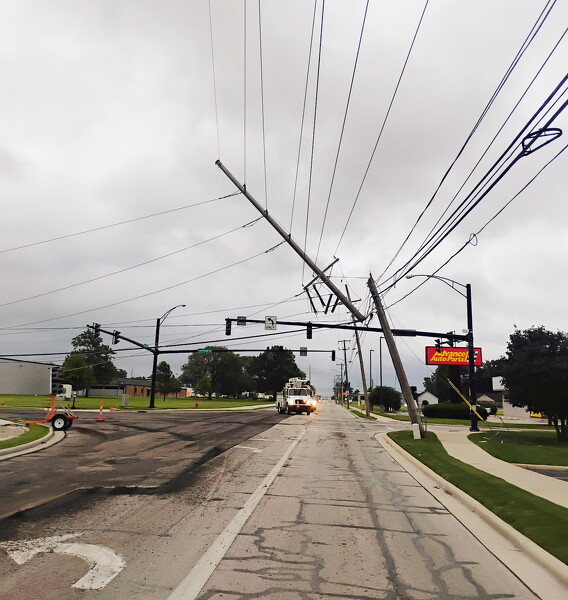
Ninety-plus mph winds on June 11th downed 15 poles, nine transmission and six distribution, on Havemann Road in Celina.
No one was injured during the late evening wind storm on June 11, though several commercial and residential structures, along with numerous power lines throughout Celina and portions of northern Mercer County sustained damage.
Not long after thunderstorm and tornado warnings were issued in Mercer County, the brief wind storm made its way into Celina from Indiana at about 11:25 p.m., meteorologist Julie Reed at the NWS Wilmington Office told The Daily Standard.
Most of the damage was focused inside the city limits of Celina.
"Straight-line winds, 90-plus mph, and it just started ripping things down. And the domino (effect) on Havemann Road: It's just like a blowing alley. When it snapped one (pole), it just kept going down," recalled Celina Mayor Jeff Hazel.
"Our entire (electric) system was out at one point, until we got things isolated and figured out what areas we could turn back on," Siefring added.
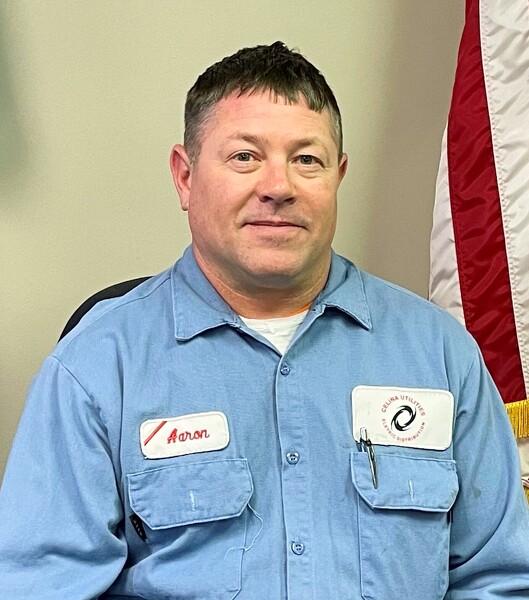
Celina electric distribution superintendent Aaron Siefring.
Siefring took time to assess the damage to the city's electrical system.
"First thing, as far as on my end, is determine the severity of the damage - what we have, what we need to replace, do we need more crews," Siefring said.
Crews had to reckon with 15 downed poles on Havemann Road - nine transmission poles and six distribution poles.
"I would say three to four hours until we got everything back on that we could before we even started doing any work in that area. We got that area isolated from everything else," Siefring said
"We've got four substations. They are so good with the loop, they can isolate sections of the city," Hazel pointed out.
"That's the beauty about how our system's looped. You don't have just one place to go through. You can loop around and segment off. So they're really good about switching to make sure to get as many people (as possible) that are unaffected by the damage, get as many people back on upfront while they work on the damaged area," Hazel said.
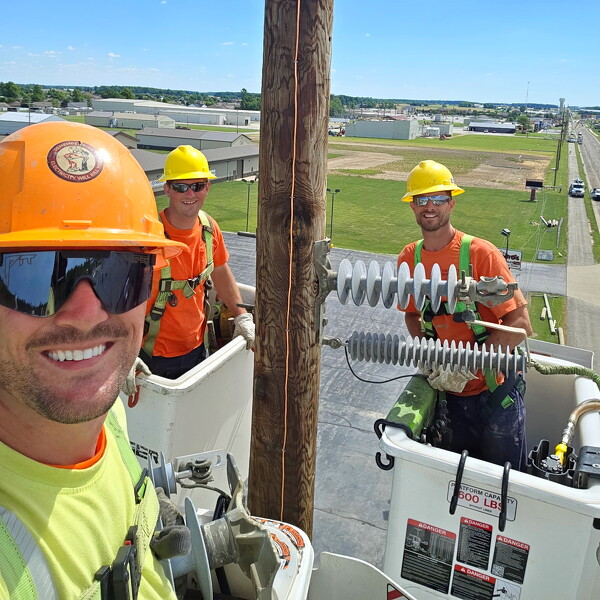
Electric linemen work to install a new transmission pole on Havemann Road in Celina.
Siefring said High-Tech Electrical Contractors of Washington Court House was called in to assist with the city's 69-kilovolt transmission lines.
"We had a contractor come in and help us with this last one, which was definitely very good for us, because they are more of a transmission contractor, transmission lines. That's what they do," Siefring said.
"That's pretty specialized for the ones that do the extra high-end transmission," Hazel said. "We just don't have the equipment."
"The mutual aid guys, these other municipals, very few work on transmission lines on a regular basis. That's what this company does. That's what they do every day, so they know what they're doing," Siefring said. "We could have got it done, yes, but they made it a lot quicker and had the equipment for it."
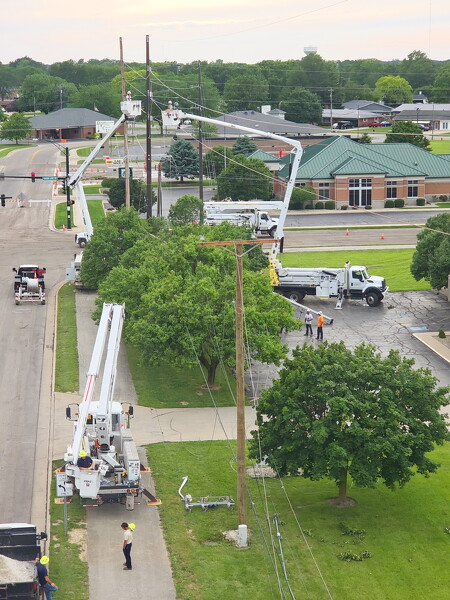
Linemen with the City of Celina work to restore power on Havemann Road following the wind storm that swept through town on the evening of June 11. Celina electric distribution superintendent Aaron Siefring said it took crews about 48 hours to get the power back on for customers.
Additionally, mutual aid was requested through American Municipal Power. Crews from Piqua, Hamilton and Bryan responded to the call. Also, the Village of Minster supplied a power pole.
Crews worked grueling 16-hour shifts to restore power.
"We had pretty much everybody back on in 48 hours. I'm guessing you add another two days to that if we didn't have (assistance from High-Tech Electrical Contractors)," Siefring said.
Hazel heaped praise on linemen for their efforts to restore power to residents, businesses and industries as quickly and, most importantly, safely as possible.
"I just think that they are a little bit of that hero in the background. The fire department is very important. They drive around with shiny trucks and people see them. They don't necessarily see the electric. They might see the yellow strobes if they're working on something, but there's a reason why they have power restored," Hazel said. "It doesn't matter what the weather is. Short of being in the tornado itself, they're out there. They're no slackers here. You've got to go out and get it done."
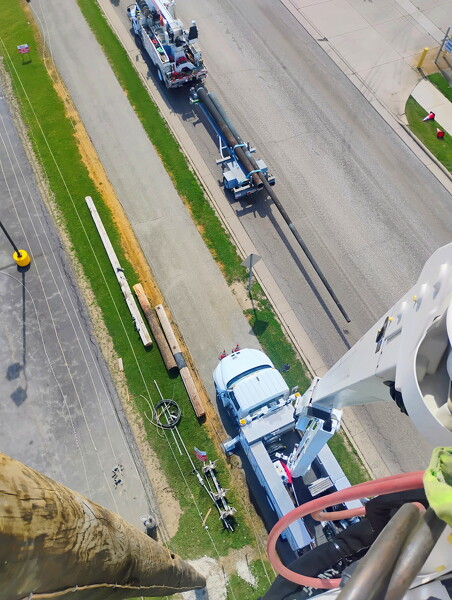
Electric linemen work to install a new transmission pole on Havemann Road in Celina.
Celina maintains its own electric system, serving roughly 7,600 customers, including about 6,800 residential customers, according to Hazel.
The city acquires electricity from nearly a dozen sources through its participation in American Municipal Power, a nonprofit wholesale power supplier.
"We're a member of AMP, and they do all our scheduling and dispatching of power through there. We negotiate rates. We are part of AMP. I mean, it's an owner-operated municipal electric, but the (municipalities) in the State of Ohio I believe account for roughly 8% of the total load that's in Ohio. About 8% of Ohio is municipal electric system."
Municipal electric systems, Hazel said, typically offer lower rates than the investor-owned utilities (IOUs) because they aren't beholden to private shareholders.
"It's a not-for-profit. Our monies that we have go right back into the system," Hazel noted. "We typically have about six months that are banked, and that will deal with any type of emergency or catastrophic events."
One of the benefits of purchasing power from a municipal electric system is the quick response time to outages and other issues, Hazel said. After hours, there are always two linemen on-call to help with electric problems.
"Our guys are here, and if there's a problem, they're here. We don't have to wait for somebody to drive up from Sidney or Dayton. We are here, and I think our service that our guys are able to give our electric department is absolutely top-notch. We are very service-oriented," Hazel maintained. "We're not looking to make a buck off of people. This is a service that comes with it. If you call an IOU out, you're going to get an upcharge on your bill because they came out. You don't get that here. It's just part of that, and our rate structure, we try to stay very, very competitive. We try to keep the rates down."
The city's electric department maintains electric distribution lines and four substations. Siefring works alongside crew leader Heath Stachler and seven linemen with multiple skill levels to ensure reliable and efficient electrical service for residents and businesses, according to Hazel.
Specifically, the department is tasked with maintaining 685 miles of distribution lines, 10 miles of transmission lines, 12 miles of fiber optic lines, four distribution substations and one 69-kilovolt substation, 24 traffic light intersections and 1,020 street lights.
"There's a lot of dangers. It's physically demanding work," Hazel said. "They have reel trailers that hold reels of electric line and they have to pull that and stretch it. There's so many different things that can happen or go wrong with that. But it is physically demanding, and it's mentally demanding. You've always got to think, 'What's the next step? What happens when I pull this? What happens when I connect this? Am I ready to splice these two?' There are a lot of elements that go in there that can be life-threatening, but they always work it like that next moment might be the last. They've got to look at it that way, because if you don't you're going to let your guard down."
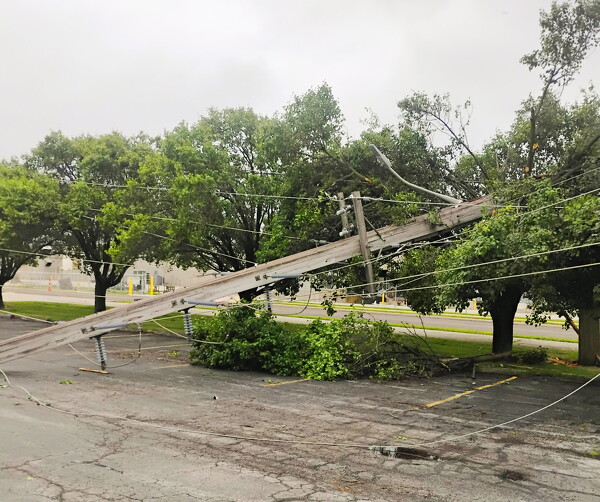
Crews had to reckon with 15 downed poles on Havemann Road in Celina after a wind storm on June 11. Nine of the 15 were transmission poles.
A citywide power outage is a relatively rare occurrence.
"The whole city … probably one every three years when we have a tornado," Hazel. "When we have a tornado, our guys are fully capable, but sometimes there's a lot of lines down, so we put a call out (through AMP) and we'll have people through Hamilton show up. AMP makes the call and they just come. It's phenomenal."
During larger-scale outages, linemen prioritize restoring power for the most amount of customers as possible.
"That's the way we try to look at it: What can get the most back on the quickest," Siefring said.
"Honestly what I see, they don't show the favoritism. They go after it," Hazel said. "And so, if you have (a situation) where there's only two people on the street, as opposed to another street that had a dozen people out, you're doing the dozen. I mean, that's just the way it is."
On the other hand, there's probably 100 isolated outages throughout the city every year, Siefring said.
"Animals, storms. There's probably 98% of outage causes," Siefring said. "(Animals) typically get into something there (in a transformer) that causes that fuse to open up."
Usually, a two-man crew is able to handle these types of outages.
"Typically, it'll be two guys to an outage to basically determine what the issue is, and if they can take care of it, they'll take care of it," Siefring said. "If not, they need more help, then they'll call to get more help. Most of the time, the two guys can take care of it. I would say 95% of the time, two guys take care of it."
Hazel and Siefring are well aware of how crucial it is for businesses to have an uninterrupted supply of electricity, such as Celina Aluminum Precision Technology.
"I was always told that … 15 minutes is about as long as they can go without power without their blast furnaces running. After that, (they) said we're automatically starting to chip aluminum slag out of their oven. They can't use it anymore," Hazel said. "They used to give me notes that it cost $100,000 a day just in chipping and losing all that aluminum."
"As far as getting power back on, it's as fast as safely possible," Siefring. "We're always trying to do our best to keep that to a minimum, the outage time."
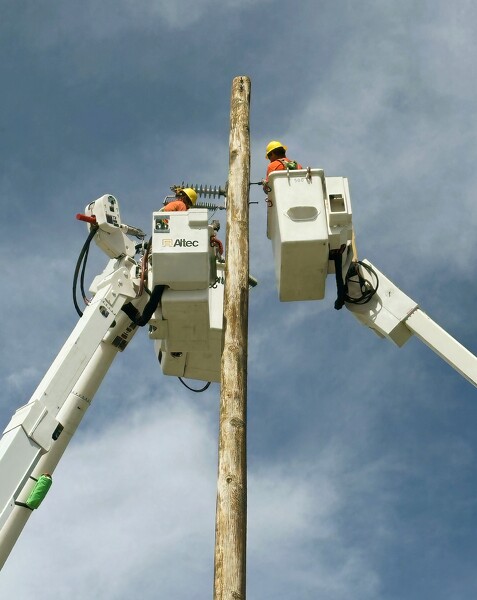
Electric linemen work to install a new pole in Celina on June 13th.
When not facing pressing issues, the electric department has plenty of work to stay busy.
"Unless we've got a job lined up specifically, we're doing maintenance, preventative maintenance, replacing poles, replacing lines," Siefring said. "This week (Oct. 19-23), we've got a new three-phase service going in that we'll be working on. Actually, there's guys working on replacing some sidewalk this week out by Summit Street substation. A lot of these guys, they come from a construction background even before they were here, where we can do some of this stuff on our own in -house. We'll do some directional boring this week up at Bryson Park for power to the new shelter houses."
Last year, the electric department replaced 175 poles and overhead primary lines, including 38,000 feet of overhead primary lines on feeder 14; completed single-phase extensions serving residents and businesses, installed additional lighting in the Bryson Park District and installed 924 new radio-read meters to improve meter accuracy and efficiency.