
The Daily Standard
Story Archive

WAPAKONETA - The Auglaize County Health Department remains on high alert for a potential measles outbreak, ramping up preparedness and continuing coordination with local healthcare providers, school officials and law enforcement.
Auglaize County has not yet had its first case of measles. However, there are four cases in Mercer County and three cases in Van Wert County, an Ohio Department of Health online database shows.
"We are doing a lot of coordination on our end, a lot of early conversations. I think we're ahead in that we already had partnerships; all we had to do was reach out to them. We've had a lot of questions and a lot of receptiveness, which is awesome," health promotion and planning director Natalie Karner informed Auglaize County of Board of Health members Tuesday morning.
Sine August, there have been eight measles deaths in the U.S. - four infants, one teenager and three adults, according to Karner. The Centers for Disease Control and Prevention has most recently reported 5,182 measles cases, though state health departments have posted numbers that indicate the national total is higher.
There are 311 cases of measles with unknown hospitalizations in Ohio, 145 cases with 25 hospitalizations in Indiana, 1,505 cases with 290 hospitalizations (99% unvaccinated) in Pennsylvania, 210 cases with unknown hospitalizations in New York and 477 cases with nine hospitalizations (99.4% unvaccinated) in Wisconsin.
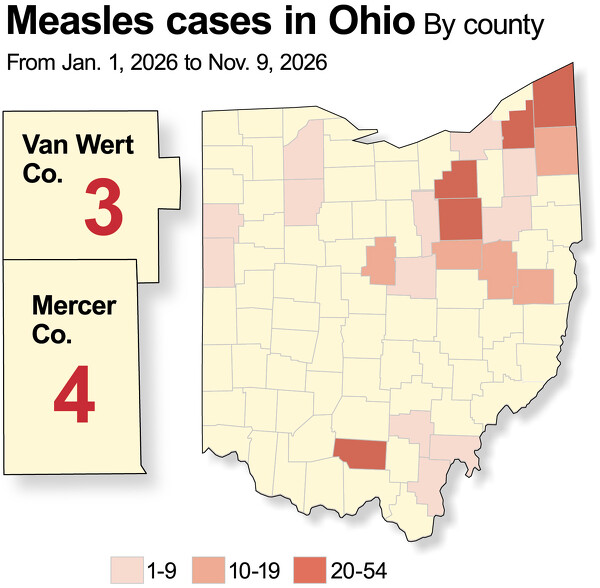
Measles cases in Ohio by county from Jan. 1 to Nov. 9, 2026
SOURCE: Ohio Department of Health
Lancaster County in eastern Pennsylvania, home to the largest Amish population in the U.S., is the epicenter of the nation's worst measles outbreak in 35 years.
Robust vaccination rates once protected Americans much better. But rates among the general public are now falling, and rates have long been low among the Amish, creating the perfect conditions for the contagious virus - officially considered "eliminated" from the U.S. since 2000 - to spread.
"Measles is circulating within our Amish population. So the cases that we've seen in Mercer and Van Wert both fall into that population," Karner said. "My understanding, the outbreaks that we're seeing in Pennsylvania and New York and Indiana are primarily in that population."
Three weeks ago, Karner said she worked with a Mercer Health infection preventionist to identify a health official in communication with the Amish population.
"We found a great contact who is very, very, very well-respected in the Amish population, who is the CEO of physician practices for Mercer Health," she said. "He has been a go-between for Mercer health department as well as their Amish population, educating them, offering them MMR (measles, mumps and rubella vaccine), offering them DTap (vaccine). He has been super, super vital in connecting them with that population."
Measles has probably been circulating in the Amish community since September, Karner pointed out.
"They thought it was a different rash. They didn't realize that it was measles," she said. "Now that they have been more informed, they are seeking care more, which is likely why we saw the confirmed case that we did in Mercer County. They sought care when maybe before they wouldn't have, because they realized the complications that measles has."
Karner said health department staff have spent much time conversing, coordinating, educating and developing materials for a social media campaign.
"I have met with all the providers for Grand Lake (Health) as well as all the providers that wanted to join," Karner said. "I met with a big group of providers at Grand Lake virtually. I met with a big group of providers at Mercer Health. I have talked to a local pediatrician about measles."
While most cases are mild, measles can cause serious and even fatal complications, such as pneumonia and encephalitis.
"One in 20 people who have measles develop pneumonia, and pneumonia is the leading cause of measles death," Karner informed board members.
Measles spreads easily when people who have it breathe, cough or sneeze, or through contaminated surfaces.
"Right now, we're hoping nobody walks into an ER. We're hoping signage helps. We're hoping education (helps)," Karner said. "If you suspect you have measles, you should call the ER you want to go to, the urgent care you want to go to, your provider - anybody where you think you need to seek care, you should call them ahead of time."
Measles first infects the respiratory tract, then spreads throughout the body, causing a high fever, runny nose, cough, red, watery eyes and a rash.
The rash generally appears three to five days after the first symptoms, beginning as flat red spots on the face and then spreading downward to the neck, trunk, arms, legs and feet. When the rash appears, the fever may spike over 104 degrees Fahrenheit, according to the CDC.
"I know Grand Lake (Health System), they're setting up testing in the parking lots similar to how they did COVID testing," Karner said. "If you suspect measles … you park, you call the number, they come out and they'll get a PCR swab."
Last week, the health department responded to a suspected measles case that turned out to be negative. Karner got the call one morning at 7:15 a.m.
"I talked to the infection preventionist. I got into the office, spoke with the provider, had the provider arrange with the mom to bring the family in a car to swab for measles," Karner recounted. "At that point, ODH (Ohio Department of Health) was concerned and asked us to possibly get a swab to them as soon as possible."
ODH was concerned because the sick child was unvaccinated and attended daycare with several other children who were also unvaccinated, she noted.
The health department managed to collect the swab and drive it to Columbus by 12:30 p.m. The test results came back in three hours.
"We knew by the end of the workday that it was negative," Karner said. "It was a child presented with conjunctivitis, cough, runny nose, and what the provider thought through the window was slight rash, and at the time had like 104 fever. It ended up being adenovirus."
Karner characterized the overall efforts as a beautifully coordinated response.
"We handled it. We had interviewed the mom, were prepared to collect contacts, told the mom what we needed, talked with the provider," Karner said. "It just so happens that I had spoken with that provider and their group the day before about measles, about what to do."
Health department officials have also been in contact with local school officials.
"I have met with all the school superintendents. I have met with all the school nurses," Karner said.
If someone with measles was at a K-12 school while they were infectious, other students who do not have two measles vaccinations or other appropriate documentation as outlined in the ODH Director's Journal Entry must be excluded from school.
Vaccination rates in the area Kindergarteners - 2025-2026 school year:
| County | Students | Schools | Rate | Non-medical exemption |
|---|---|---|---|---|
| Mercer | 539 | 6 | 82% | 16.5% |
| Auglaize | 513 | 8 | 81.7% | 3.1% |
| Darke | 609 | 9 | 85.1% | 13.3% |
| Van Wert | 266 | 4 | 79.7% | 5.3% |
Students must be excluded for 21 days after the onset of the most recent case in the school. The exclusion period can be extended if additional cases are identified, according to ODH.
"This is a very tough conversation with our superintendents," Karner said. "It is required by Ohio Revised Code and Ohio Administrative Code. I have sat down, we've talked about the code, we have talked about the formulas. We've talked about where their risks are."
If a student was previously unvaccinated and receives a dose of measles vaccine within 72 hours of the first exposure, they may be readmitted to school. However, these students should monitor for signs and symptoms of measles, according to ODH.
Students who previously received one dose of measles vaccine can return to school once they receive their second dose. Doses of measles vaccine must be separated by at least 28 days.
"I have told schools their highest risk is not going to be in the population that already had two doses of MMR. It's going to be in those students who start their MMR series and come back to school," Karner said. "Because if one of those develops symptoms, that exclusion restarts."
According to ODH, the first dose of MMR should be administered to a child at 12 to 15 months. The second dose should come at 4 to 6 years. MMRs can be given to children as young as 6 months of age who are at high risk of exposure, such as during a community outbreak or international travel.
"(If) we have a parent coming in and asking for it - according to the pediatricians I talked to in both health systems - they are getting it," Karner said.
As of last year, there were a couple of schools in Auglaize County with MMR immunization rates below 80%.
"We had a school as low as 75%. So that meant 25% of their kindergarten class had waivers and none of them were medical waivers. They were all religious or conscience … waivers," Karner said. "So we are seeing an increase in vaccine hesitancy in using those waivers and that does put us at risk."
- The Associated Press contributed to this article.