
The Daily Standard
Story Archive

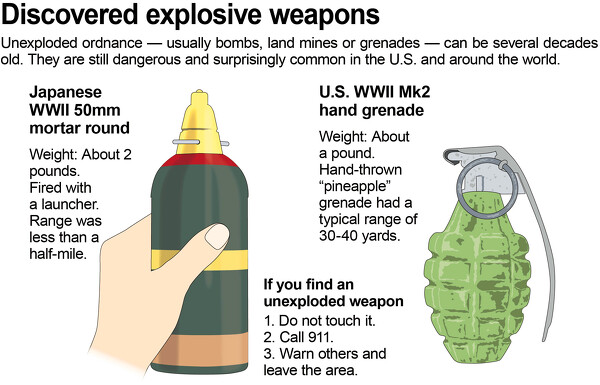
Unexploded ordnance - usually bombs, land mines or grenades - can be several decades old. They are still dangerous and surprisingly common in the U.S. and around the world.
NEW BREMEN - State and local officials responded quickly Sunday to a call about a military explosive device homeowners found while clearing out a house.
"Yesterday, one of our officers was stopped by a resident (who) notified him of a small ordnance they found in a house that belonged to a family member," New Bremen Police Chief Mike Skinner said. "The ordnance was the size of a pop can, possibly from the World War I or World War II era. Wright-Patterson Air Force Base was contacted and they sent their bomb squad to dispose of the device."
No one was injured.
According to Skinner, the department received contact at 1:55 p.m. from family members who were cleaning out the home of a recently deceased family member.
The residence is 107 W. Plum St., New Bremen. According to the Auglaize County Auditor, the home belongs to West Plum Street LLC, a business registered to Bridget Koeper of New Bremen, according to the Ohio Secretary of State.

A World War II-era ordnance, thought to be a Japanese 50 mm mortar round, was found Sunday while owners were clearing out this house on Plum Street in New Bremen.
Skinner told The Daily Standard the device was a Japanese type 50mm mortar round, an explosive used for short-range indirect fire.
Auglaize EMA Director Troy Anderson said he thinks it was a World War II-era weapon. He said he thinks it's a WWII round that a soldier "probably brought back" or someone bought it later in life.
Because the police department has no expertise in explosives, Skinner said, it contacted Wright-Patterson Air Force Base, which dispatched a team to dispose of it by detonating it at the police department's gun range outside town.
The Explosive Ordnance Disposal flight at Wright-Patterson is part of the 788th Civil Engineer Squadron and is responsible for safely disposing of all military ordnance found on Wright-Patterson AFB and the surrounding area.
"Wright-Patterson took care of it," he said. "We no longer have it in our village. We have zero expertise in explosions, no training at all, and that's completely up to them."
Skinner said he is grateful no one was harmed and the explosive was safely disposed of.
There have been a couple of times when a resident has contacted the department about military equipment.
"Sometimes, depending on what the device is, (Wright-Patterson personnel) pack it up and take it back," he said. "If it's something that they feel is not safe, which I can only remember one time, they go ahead and detonate it."
Anderson said those calls can typically occur during garage or estate sales.
The Department of Defense Environment, Safety & Occupational Health Network and Information Exchange (DENIX), a platform for sharing and reporting DOD information with the public, has the following guidance on what to do if someone suspects they have found military munitions:
Individuals should recognize, retreat and report, commonly referred to as the 3Rs.
"Recognize when you may have encountered a munition and that munitions are dangerous," the site reads. "Do not approach, touch, move or disturb it, but carefully leave the area. Call 911 and advise the police of what you saw and where you saw it."
"To avoid munitions, retreat by retracing your steps out of the area in the same direction from which you entered it," the site continues. "Do not go near the munition, do not touch it and do not move it. Do not explore the area. Try to remember the area in which you saw the munition. If possible, when you are safely away from the munition, mark the area with a piece of clothing."
If someone picks up a munition or moves it, it can explode and injure or kill nearby persons.
DENIX reports that munitions can come in several shapes and sizes, as "some look like bullets or bombs while others look like pointed metal pipes, soda cans, small balls, or even an old car muffler."
They can look new or old, can be found alone or in clusters, and are extremely dangerous.